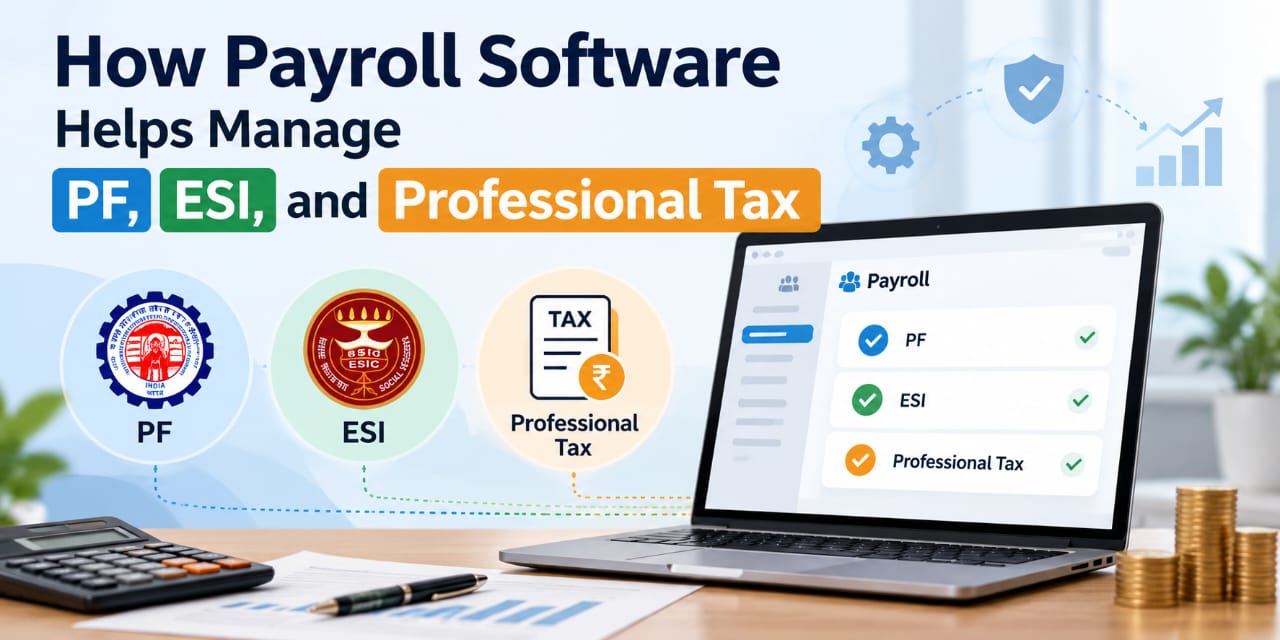
Every month, Indian HR teams face the same compliance challenges: Provident Fund (PF), Employee State Insurance (ESI), and Professional Tax (PT). Each of them follows different rules, different rates, and different deadlines. Despite being complex, if you miss one, penalties, interest, and uncomfortable employee conversations follow.
Earlier, spreadsheets worked when companies had fewer employees. They fail the moment headcount grows, offices spread across states, or a rule changes mid-year. This is where the top payroll software in India earns its place. Let us look at how implementing dedicated payroll software makes PF, ESI, and PT easier to manage.
Why PF, ESI, & PT are Challenging for HR Teams
PF, ESI, and PT are highly relevant in Indian payroll compliance:
- Provident Fund is a retirement savings scheme where the employer and employee each contribute 12% of eligible wages, up to a statutory wage ceiling.
- Employee State Insurance is a health and social security scheme for employees earning below a set monthly wage threshold, funded by both sides.
- Professional Tax is a state-levied tax on income, with slabs that change from one state to the next.
While each looks manageable, together, they are a challenge, as:
- Wage ceilings get revised periodically.
- Employees join and leave mid-month.
- A salary hike pushes someone past the ESI threshold halfway through the year.
- A transferred employee finds themselves under a different state’s Professional Tax slab.
Manually tracking these numbers turns each of these events into a possible miscalculation, and every error in statutory compliance is an expensive one.
How Payroll Software handles PF
Payroll software removes the guesswork from PF. Once salary components are configured, the system identifies which components count as PF wages, applies the contribution rate, and splits the amount between the employer and employee shares, including the pension and administration breakdowns. Employees who opt for voluntary contributions above the standard rate are handled without separate calculations.
A robust employee management system generates the ECR file in the format the EPFO portal accepts, so HR simply uploads it instead of preparing it manually. UAN details stay linked to employee records, which cuts rejections caused by missing or mismatched data.
Since contributions are due by the 15th of the following month, automated reminders help HR teams stay on top of it. Arrears, loss of pay days, and recruits are adjusted within the same cycle, so the figures on the challan match the figures on the payslip.
How Payroll Software handles ESI
ESI looks simple until eligibility of employees starts shifting mid-year. An employee is covered only while gross monthly wages stay within the government-specified threshold, and contributions follow fixed contribution periods rather than calendar months. Tracking it manually across hundreds of employees is not only error-prone, but also time-consuming.
On the other hand, payroll software checks eligibility every month, applies the employer rate of 3.25% and the employee rate of 0.75%, and handles contribution period logic automatically. When a salary revision pushes someone over the threshold, the system highlights it automatically, helping HR approve the required changes in their salary structure.
Similarly, reports generated by the system are ready for the ESIC portal, covering contribution details, insured person numbers, and attendance-linked wage data, which further minimizes the chances of errors.
How Payroll Software handles PT
PT is where manual processes collapse, as there is no national rate. Each state sets its own slabs, deduction months, and filing frequency, and some states apply special rules for particular months or categories of employees. The annual cap is ₹2,500 per employee, but the way it is configured differs from one state to another.
A company with offices in Maharashtra, Karnataka, and Tamil Nadu cannot run one payroll formula for everyone. Payroll software maps each employee to a work location and applies the correct state slab automatically.
Registration numbers, due dates, and return formats are stored state-wise, so monthly or annual filings are prepared without a scavenger hunt across state portals. When an employee transfers, updating the location is enough, as the next payroll cycle chooses the right slab automatically, based on their new location.
Beyond Calculation – The Compliance Safety Net
A strong payroll system also builds a compliance safety net for HR teams and the organization. Due date alerts prevent late payments. Similarly, audit trails record who made changes and when, which makes the system foolproof and highly reliable.
The statutory rules also keep changing. Labour code reforms, revised wage definitions, and state-level amendments arrive regularly. Payroll software vendors track these updates and integrate them into their payroll system, so HR need not rebuild their formulae every time a change occurs in compliance. The result is cleaner payslips, fewer employee queries, and fewer late-night changes. Hence, payroll software acts as a compliance safety net beyond automated calculations.
Conclusion
Also read: The Impact Of Technology On Online Slot Development
PF, ESI, and Professional Tax compliance does not have to be a monthly crisis. With the right software, calculations run automatically, filings stay accurate, and deadlines stop being a headache. The best payroll systems in India, like Pocket HRMS, bring payroll, attendance, and statutory compliance into a single platform, so your team spends time on people instead of paperwork.